Fully Licensed TPCL #13381

Texas’ 5 star ⭐⭐⭐⭐⭐ Trusted Name in Pest Protection

Our Socials

Carpenter Ant Control in Crockett, TX — Protect Your Home's Structure

Seeing big black ants around your house? Finding piles of sawdust near wood? Finding winged ants emerging from walls or ceilings in spring?

You might have carpenter ants. And unlike regular ants, these guys are destructive.

Carpenter ant close-up showing wings

READY TO GET STARTED?

Main Popup Form
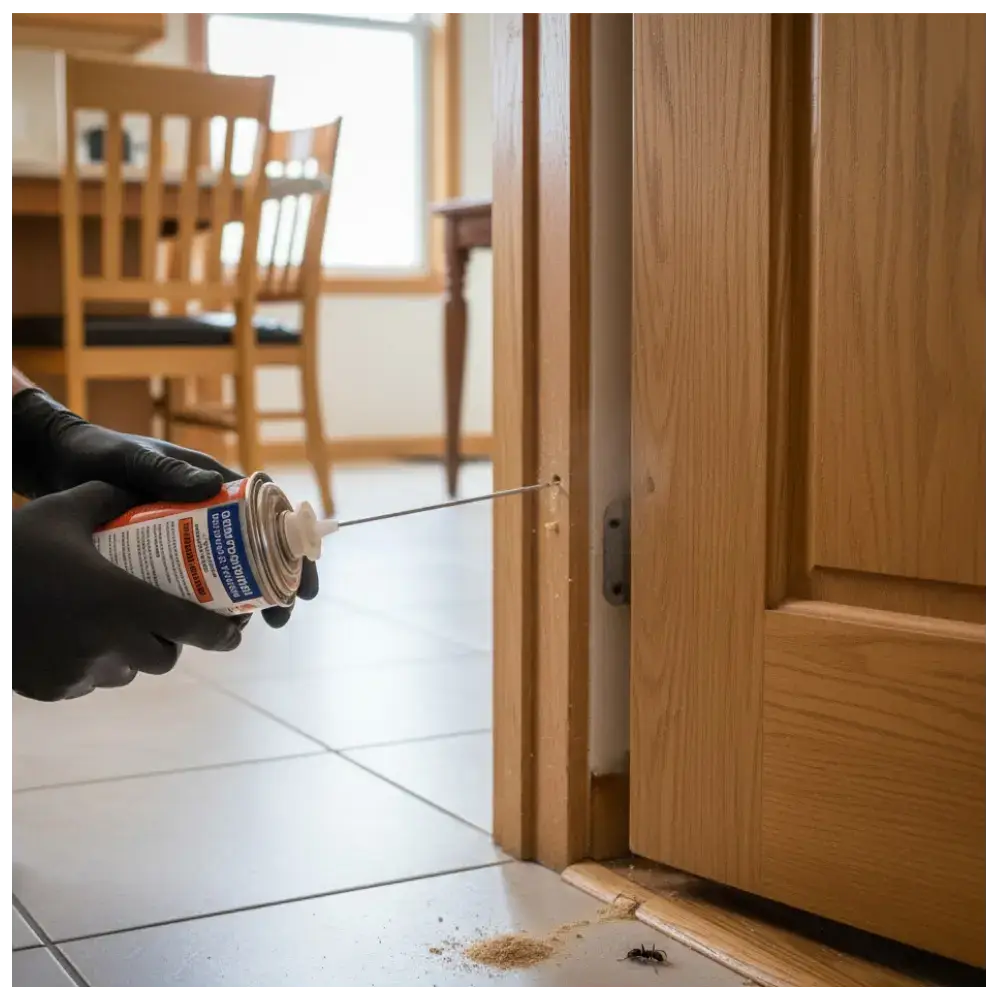
Carpenter ant treatment near wood

Carpenter Ants vs. Termites: A Critical Distinction

Carpenter ants are the most commonly misidentified structural pest in East Texas. They are large — up to half an inch — dark brown or black, and may have wings during swarm season. They don’t eat wood like termites. Instead, they excavate galleries inside moisture-damaged wood to nest, producing sawdust-like frass (unlike termite mud tubes and digested wood).

The distinction matters because the treatment is completely different. Our blog on how to tell carpenter ant vs. termite damage apart covers the physical evidence in detail. If you’re unsure, call us — a misdiagnosis wastes months of treatment on the wrong pest.

Critical alert: carpenter ant infestations frequently co-occur with termite activity. Both species prefer moisture-damaged wood, which means a home with one often has conditions favorable to the other. If we find carpenter ants during inspection, we always recommend a concurrent termite inspection and WDO report to rule out subterranean termites working in the same wall section.

Finding and Eliminating the Colony

Carpenter ant colonies have a parent nest — in decayed wood or a moisture-damaged structural member — and satellite nests throughout the building. Most carpenter ant treatments fail because they kill the workers while the parent colony deep inside a wall void survives and keeps producing new workers.

Texas A&M AgriLife Extension on carpenter ants and moisture damage confirms that carpenter ants require moisture-damaged wood to establish. Finding the parent colony means finding the moisture source: roof leaks, plumbing penetrations, grade-level wood-to-soil contact, or improperly flashed windows. We identify these conditions as part of every carpenter ant inspection.

We treat with non-repellent residual insecticides that workers transfer to the colony and baits that reach the queen. We also review your property for the wood moisture conditions that attracted the colony in the first place. Fixing the conditions that created the opportunity is what prevents re-infestation. The Texas Department of Agriculture regulates wood-destroying insect treatment licensing — we are fully licensed for WDI treatment.

For properties where carpenter ants appear alongside active termite pressure, we can coordinate concurrent treatment with our Sentricon Always Active termite program — addressing both wood-destroying pests in a single comprehensive plan.


Blue and white triangle graphic

process

Our Pest Control Process

Calendar scheduling inspection service

Connect & Schedule

Your protection starts with a simple conversation.


Our friendly customer service team listens to your concerns, answers questions, and helps schedule an inspection or service visit at your convenience.

Critter Gitters pest control logo

Inspection & Diagnosis

We Identify the Source


Our certified technicians perform a detailed inspection of your property — inside and out. We identify pest types, entry points, and contributing conditions to determine exactly what’s happening and why.

Gear icon representing pest control process

Customized Treatment

Science-Based Targeted Solution

Using proven Integrated Pest Management (IPM) principles, we design a treatment plan tailored to your home, pest type, and environment. We use precision applications — not overuse — to ensure safe, effective, and lasting results.

Integrated pest management solutions

Guaranteed Results

Professional Service Guaranteed


Our trained specialists apply targeted treatments using the latest tools and environmentally responsible products.
 We treat interior and exterior zones, eliminate nests and harborage areas, and establish a protective barrier around your home.

Integrated Pest Management principles

Certified Local Expertise

Integrated Pest Management principles

Family-Focused Service

Integrated Pest Management principles

Guaranteed Results

WHY CHOOSE US

Why Homeowners Across East Texas Trust Critter Gitters

Science-Based Solutions, Never Guesswork

Reflects your belief that true pest control starts with understanding, not guessing. Drawn from your Integrated Pest Management (IPM) philosophy and “Precision Over Routine”.

We lead with honesty and reliability. At Critter Gitters, integrity means fair pricing, clear communication, and doing the job right the first time—every time.

Our technicians undergo continuous training that goes beyond industry requirements, ensuring every service is performed with expert knowledge, precision, and the latest pest control techniques.

Our team is fully licensed and certified, bringing proven expertise to every job. You can trust Critter Gitters for safe, professional, and effective pest control backed by years of experience.

Your satisfaction is our promise. If the covered pests come back, so will we – 100% satisfaction guaranteed.

Pest control technician spraying window
Critter Gitters pest control logo

Packages

Bundle and Save 10% when you add Mosquito Duo Defense or Lawn & Ornamental to any package.

Package Includes

Essential Plan

Essential

Proven protection for everyday peace of mind.

Premium Plan

Premium

Enhanced protection. Expanded peace of mind.

Elite Plan

Elite

Complete coverage. Ultimate peace of mind.

Ants (Argentine, Rover & Odorous House)

Blue gradient pest control graphic

Roaches (Peridomestic species)

Blue gradient pest control graphic

Spiders, Millipedes, Centipedes, Crickets, Earwigs, Silverfish, Ground Beetles, Pill Bugs, and other occasional invaders

Blue gradient pest control graphic

Interior and exterior treatments every 3 months

Blue gradient pest control graphic

Targeted crack, crevice, and perimeter applications

Blue gradient pest control graphic

Web and wasp nest removal up to 15 ft

Blue gradient pest control graphic

Guaranteed re-service between visits if pests return

Blue gradient pest control graphic

Rodent monitoring and exterior bait stations

Red circular graphic design
Blue gradient pest control graphic

Wasp nest removal up to 30 ft

Red circular graphic design
Blue gradient pest control graphic

Fire Ant treatment up to 20,000 sq ft

Red circular graphic design
Blue gradient pest control graphic

Full Sentricon® Termite Monitoring System

Red circular graphic design
Blue gradient pest control graphic

Carpenter Ant treatment

Red circular graphic design
Blue gradient pest control graphic

Additional Services

Need more than standard pest control? Our advanced services deliver customized protection for complex infestations, long-term prevention, and total peace of mind.

Blue and white triangle graphic

FAQ’s

Common Questions from Our Customers

Pest control technician treating home
How do I know if I have carpenter ants or termites?

Carpenter ants produce clean, sawdust-like frass. Termites produce mud tubes and a material that looks like compressed wood fiber. Carpenter ant damage is smooth and clean — termite damage is rougher with soil packed in. Our blog on carpenter ant vs. termite damage identification has photos of both for comparison.

Most common parent nest locations: attic eaves near roof leaks, bathroom walls adjacent to plumbing, window frames with moisture intrusion, and any wood that has ground contact or persistent moisture exposure. Satellite nests can appear anywhere — including inside foam insulation and hollow-core doors.

Over-the-counter sprays kill the workers you see and repel others — which causes the colony to fragment and spread deeper into the structure. This makes the infestation harder to treat professionally. If you suspect carpenter ants in your walls, the most cost-effective first step is a professional inspection.

 Ideally, both happen close together. We can treat the ant colony while you address the moisture source, or we can treat first and follow up to verify elimination once repairs are made. Treating without fixing moisture will result in re-infestation within 6–18 months.

Carpenter ants can bite if handled directly but are not aggressive and don’t sting. The danger is structural: a large colony excavating in wall studs, floor joists, or roof rafters weakens structural integrity over time. The damage isn’t as fast as termites, but it’s real and progressive.

Request a Free Pest Evaluation

hero form