
Why Fire Ant Activity Spikes in Spring—and What East Texas Homeowners Can Do About It
If you’ve noticed more fire ant mounds popping up around Crockett, Grapeland, and Palestine this month, you’re not imagining it. Every year, right around late April into May, we see a sharp spike in fire ant activity across Houston County and surrounding areas. As someone who has spent decades diagnosing and treating pest issues in East Texas, I can tell you this isn’t random—it’s predictable, seasonal, and tied directly to our soil, moisture, and temperature patterns.
For homeowners across the region—especially those searching for reliable Houston County pest control—understanding what’s happening right now is the first step toward controlling it effectively.
Why Spring Is Peak Fire Ant Season in East Texas
Fire ants don’t just “show up” in spring. They’ve been there all along, living underground through the winter months. What changes in April and May is environmental activation.
As soil temperatures consistently rise above ~70°F and we begin to see more regular rainfall, colonies shift into aggressive growth mode. Queens ramp up egg production, worker populations expand rapidly, and colonies begin foraging more visibly above ground.
Spring also marks nuptial flight season, when winged reproductives take flight to establish new colonies. This is why properties in areas like Kennard and surrounding rural zones often experience sudden increases in mound activity almost overnight.
In practical terms:
- Warmer soil accelerates colony growth
- Increased moisture improves survival and expansion
- Reproductive flights create new infestations across your property
This is exactly why April and May are consistently the worst months for fire ants in East Texas.
Why Houston County Properties Get Hit Harder
Not all regions experience fire ants the same way—and Houston County has several environmental advantages that favor infestation growth.
Sandy, Well-Draining Soil
Fire ants thrive in loose, sandy soil because it allows easy tunneling and stable mound construction. Much of the soil profile in and around Crockett supports rapid colony expansion.
Open, Sun-Exposed Lawns
Fire ants prefer sunlight. Residential lawns, open acreage, and lightly shaded properties provide ideal nesting conditions.
Moisture and Rain Cycles
After spring rains, colonies often push upward to avoid saturated soil. That’s when visible mounds suddenly appear across lawns, fence lines, and driveways.
Reduced Natural Competition
In maintained residential environments, competing species are limited—allowing fire ants to dominate quickly.
This is why many homeowners don’t just experience fire ants once—they deal with recurring infestations season after season unless proper control methods are used.
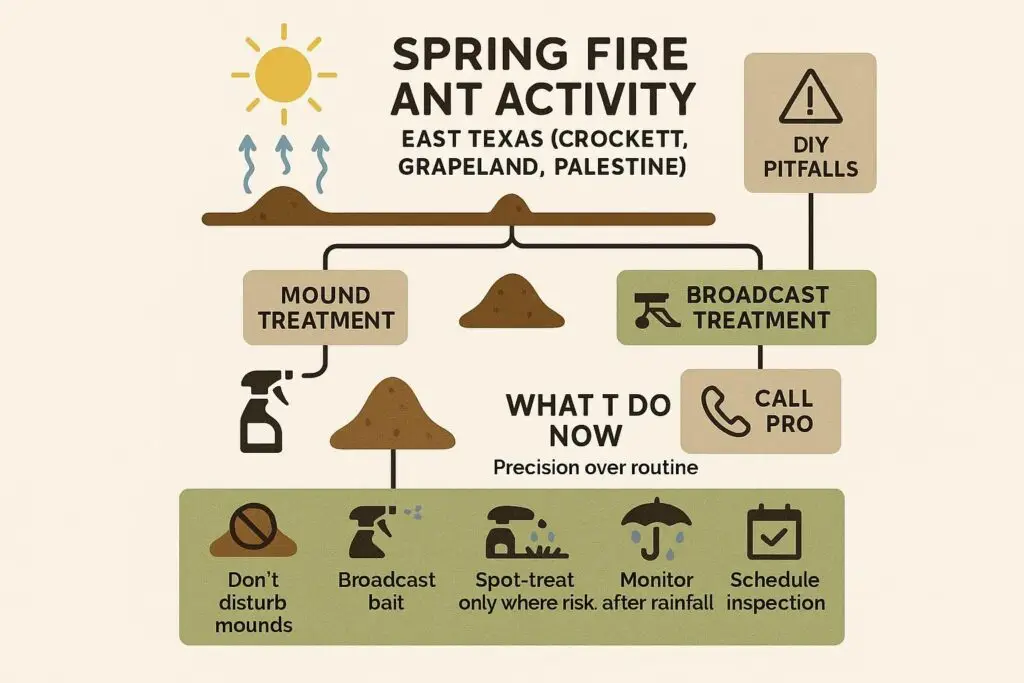
Mound Treatment vs. Broadcast Treatment: What Actually Works
One of the most common mistakes we see is focusing only on what’s visible. Effective fire ant control requires targeting the entire colony system—not just the mound.
Mound Treatment (Reactive Approach)
This method involves treating individual mounds directly using liquid drenches or contact insecticides.
Where it helps:
- Immediate knockdown of visible mounds
- Useful near patios, walkways, and high-traffic areas
Where it fails:
- Only treats what you can see
- Does not eliminate nearby or developing colonies
- Can cause colony relocation or splitting if done improperly
Mound treatments are short-term solutions, not long-term control.
Broadcast Treatment (Systemic Control)
This is the method professionals rely on for effective, lasting results.
Broadcast treatments involve spreading granular bait across the entire property. Worker ants carry the bait back to the colony and distribute it—including to the queen.
Why this works:
- Eliminates the queen, which is essential for colony collapse
- Targets multiple colonies at once
- Provides ongoing suppression of new infestations
In most cases, the best approach is a combination of both—broadcast treatment for overall control, paired with targeted mound treatments where needed. This is the foundation of effective fire ant control programs.
Why Home Remedies Don’t Work
There’s no shortage of DIY solutions—boiling water, vinegar, dish soap, grits—but these approaches consistently fail for one simple reason:
They don’t eliminate the queen.
Fire ant colonies are highly resilient. Killing surface workers doesn’t solve the problem. In fact, disturbing colonies with improper treatments often causes them to split and spread, creating more mounds instead of fewer.
Additionally:
- Most DIY methods don’t penetrate deep enough into the colony
- They offer no residual or preventative protection
- They fail to address multiple colonies across the property
This is why homeowners often feel like they’re constantly chasing new mounds without ever solving the issue.
When to Call a Professional
Fire ant problems escalate quickly, especially during peak season. There’s a point where control requires a structured, science-based approach—not trial and error.
You should consider professional service if:
- You’re seeing multiple mounds across your property
- Activity continues after repeated treatments
- You have children, pets, or outdoor spaces at risk
- Infestations are spreading to new areas
Professional services don’t just treat existing colonies—they build a long-term prevention strategy tailored to your property. Whether you’re in Crockett or nearby areas like Palestine, homeowners often benefit from integrating fire ant solutions into a broader ant control or seasonal pest management plan.
What Crockett Homeowners Should Do Right Now
If you’re dealing with fire ants this April in Crockett, Grapeland, or surrounding areas:
- Avoid disturbing mounds unnecessarily
- Use broadcast bait treatments for wider control
- Spot treat only where immediate risk exists
- Monitor activity after rainfall
- Act early before colonies multiply
Fire ants don’t go away on their own. Left untreated, infestations will expand throughout the season.
For homeowners looking for consistent protection beyond just fire ants, structured service plans like those found in our pest control packages can provide year-round coverage and prevention.
Final Thoughts: Precision Over Routine
Fire ant control isn’t about reacting—it’s about understanding the problem beneath the surface and applying the right solution at the right time.
If you’re seeing increased activity across your property, the most effective next step is to address the issue at the colony level—not just the mound.
Learn more about our professional approach to fire ant control
Or reach out directly through our contact page to schedule an inspection
At Critter Gitters, we don’t rely on guesswork. We diagnose, treat, and protect—so you can enjoy your property without the constant frustration of recurring fire ant infestations.