
You’re sitting in your living room on a warm April evening in Palestine, and you notice something strange. Winged insects hovering near the windows. A small pile of discarded wings on the windowsill. Maybe you saw them emerging from a crack in the wall or near the baseboards.
Your first thought: “Flying ants?”
Probably not. If you’re seeing winged insects inside your home during spring, there’s a good chance they’re termite swarmers. And that’s not good news.
Here’s what most people don’t realize – by the time you see termite swarmers inside your house, there’s already an established colony living in your walls. They’ve been there for months, maybe years, silently eating away at the wood structure of your home.
Spring is termite swarm season across East Texas. And if you’re in Palestine, Crockett, Grapeland, or anywhere in Anderson County, your home is at risk.
Here’s what you need to know about termites, how to spot the signs, and what to do before the damage gets worse.
Why Spring Is Termite Swarm Season
Termites live in underground colonies with one job: eat wood and expand the colony. Most of the year, you’ll never see them. They stay hidden in the soil and inside the wood they’re consuming.
But in spring – usually March through May in East Texas – something changes.
The colony sends out reproductive termites called “swarmers” or “alates.” These are the winged termites you see flying around. Their job is to find a mate, land somewhere suitable, shed their wings, and start a new colony.
Swarms typically happen on warm, humid days after rain. Perfect conditions in Palestine during April and May.
If you see swarmers outside near a tree stump or old wood pile, that’s normal. They’re not a threat to your house.
If you see swarmers inside your home, that’s a problem. It means there’s already a mature colony living in or under your house. They’re emerging from inside your walls, not flying in from outside.
And by the time a termite colony is mature enough to produce swarmers, they’ve been feeding on your home’s wood structure for 3-5 years. The damage is already happening.
How to Tell If Those Winged Insects Are Termites
Not every flying bug is a termite. Flying ants also swarm in spring, and people confuse them all the time.
Here’s how to tell the difference:
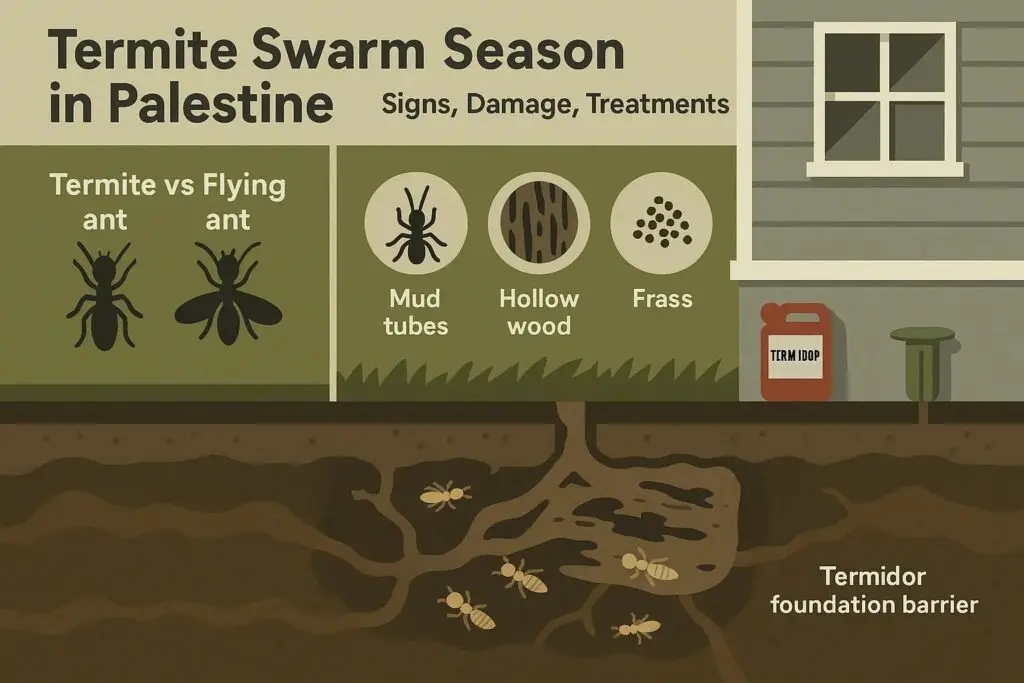
Termite Swarmers:
- Two pairs of wings that are equal length (all four wings look the same size)
- Straight antennae
- Thick, straight body with no narrow waist
- Usually light brown, tan, or black depending on species
Flying Ants:
- Two pairs of wings, but the front wings are longer than the back wings
- Bent or elbowed antennae
- Pinched waist (narrow section between thorax and abdomen)
- Usually black or reddish-brown
If you’re not sure what you’re looking at, save a few of the insects or wings in a plastic bag and call us. We’ll identify them for free.
But if you’re seeing them inside your Palestine home in spring, assume termites until proven otherwise.
The Hidden Signs of Termite Damage
Most termite damage happens where you can’t see it. Inside walls. Under floors. In crawlspaces. By the time you notice obvious damage, they’ve been eating your house for years.
Here are the warning signs Palestine homeowners need to watch for:
Mud Tubes on Your Foundation
Subterranean termites (the kind we deal with in East Texas) live underground. They build mud tubes – narrow tunnels made of soil and wood particles – from the ground up to the wood they’re feeding on.
These tubes are about the width of a pencil and usually run up your foundation, slab, or brick veneer. Check around the perimeter of your house, especially in shaded areas, near air conditioning units, or where the foundation meets the siding.
If you see mud tubes, you have active termites.
Discarded Wings Near Windows and Doors
After termite swarmers land and find a mate, they shed their wings. You’ll find small piles of discarded wings near windowsills, door frames, or on the floor near walls.
These wings are all the same size and shape – a key difference from ant wings.
Hollow-Sounding Wood
Termites eat wood from the inside out. The surface might look fine, but tap on baseboards, door frames, or window sills. If it sounds hollow or feels soft when you press on it, termites might have eaten the interior.
You might also notice wood that feels papery or crumbles easily when you push on it.
Sagging Floors or Ceilings
If termites have damaged floor joists or ceiling beams, you’ll eventually notice sagging, warping, or unevenness. Floors might feel spongy. Ceilings might have visible dips.
This is advanced damage. If you’re seeing this, the infestation has been there for a long time.
Doors and Windows That Stick
Termite damage can cause wood to warp. If doors or windows that used to open easily now stick or won’t close properly, it might be termite damage (or moisture issues – which also attract termites).
Small Piles of “Sawdust”
This is actually termite droppings (called “frass”). It looks like tiny pellets or sawdust piles near baseboards, in corners, or on windowsills.
Subterranean termites don’t usually leave frass – that’s more common with drywood termites. But if you see it, you’ve got termites somewhere.
Why Palestine and Anderson County Homes Are at Risk
East Texas is prime termite territory. We’ve got everything termites need to thrive.
Humidity
Palestine averages 60-70% humidity year-round. Termites need moisture to survive. The more humid it is, the easier it is for them to stay active and spread.
Older Homes with Wood Construction
Anderson County has beautiful historic homes and established neighborhoods. Many were built in the 1950s-1980s with wood siding, pier and beam foundations, and wood framing.
Older homes often have:
- Wood-to-soil contact (where siding or framing touches the ground)
- Cracks in foundations that give termites easy access
- Moisture problems from aging plumbing or poor drainage
- Untreated wood that termites love
All of this makes older Palestine homes perfect targets.
Sandy Soil
Much of Anderson County has sandy soil. Termites tunnel through it easily, spreading from property to property without you ever seeing them above ground.
Wood Debris and Landscaping
Old tree stumps. Firewood stacked against the house. Mulch piled against siding. Landscape timbers. All of these attract termites and give them a food source close to your home.
Once they finish eating the stump or firewood, they move right into your house.
The Two Types of Termite Treatment: Termidor vs. Sentricon
If you’ve got termites, you need professional treatment. DIY treatments don’t work. Store-bought products don’t penetrate deep enough or treat the entire colony.
At Critter Gitters, we offer two proven termite control methods: Termidor liquid treatment and the Sentricon Always Active system. Both work, but they work differently.
Termidor Liquid Treatment
This is the faster option for active infestations.
We trench around your foundation and apply Termidor – a professional-grade termiticide – into the soil. It creates a continuous barrier that termites can’t detect.
When termites cross the treated zone (either coming or going), they pick up the product on their bodies. They carry it back to the colony and spread it to other termites through contact and grooming. Within days to weeks, the colony collapses.
Best for:
- Active infestations that need immediate treatment
- Real estate transactions (buyers need fast treatment before closing)
- Homes where monitoring stations aren’t practical
How long it lasts: Termidor provides protection for 5-10 years depending on soil conditions. After that, retreatment is needed.
Sentricon Always Active System
This is what Joey recommends for long-term protection – and it’s what he has on his own Palestine-area home.
Here’s how it works: We install monitoring stations around the perimeter of your home (usually every 10-20 feet). These stations contain bait that termites actually prefer over wood.
When termites find the stations, they feed on the bait and share it with the colony – including the queen. The bait disrupts their growth process. They can’t molt, can’t mature, and the colony dies out.
Best for:
- Long-term, continuous protection
- Homes where you don’t want trenching or drilling
- Properties with ongoing termite pressure
- Homeowners who want year-round monitoring
Why Joey chose Sentricon for his own home:
He’s seen every termite treatment out there – worked with them all during his seven years at Disney World and almost 20 years running Critter Gitters.
Sentricon is included in our Elite Plan because it’s the most effective long-term solution. No trenching every few years. No reapplications. Just continuous monitoring and protection.
It’s the same system protecting the Statue of Liberty, the White House, and millions of homes across the country.
Which Treatment Is Right for Your Palestine Home?
If you have active termites right now and need them gone fast: Termidor liquid treatment is the answer. Works quickly, eliminates the colony, provides years of protection.
If you want ongoing protection and peace of mind: Sentricon system monitors 24/7 and eliminates colonies before they cause damage. It’s included with our Elite Plan, which also covers your regular pest control and carpenter ants.
We’ll inspect your home, assess the situation, and recommend the best approach for your specific property.
What Happens If You Ignore Termites
Termites don’t go away on their own. They just keep eating.
Here’s what happens when Palestine homeowners ignore the signs:
Year 1-2: Minor damage to framing, studs, or floor joists. You probably won’t notice anything yet.
Year 3-5: Visible damage starts showing up. Hollow-sounding wood. Mud tubes on the foundation. Swarmers inside the house. Repair costs are climbing.
Year 5+: Structural damage. Sagging floors. Compromised support beams. Major repairs needed – potentially tens of thousands of dollars.
The worst part? Homeowner’s insurance doesn’t cover termite damage. It’s considered preventable. You’re paying for all repairs out of pocket.
The average termite repair costs $3,000-$8,000. Severe cases can hit $20,000 or more if structural framing needs replacement.
Prevention and early treatment cost way less than repair.
Termite Inspections for Palestine Home Buyers and Sellers
Buying or selling a home in Palestine? Most lenders require a termite inspection (also called a WDI or WDO report) before closing.
We provide thorough termite inspections that meet Texas real estate requirements. Joey or one of our licensed inspectors will check the entire accessible structure – foundation, crawlspace, attic, interior, exterior.
For Buyers:
You’ll know exactly what you’re getting into before closing. If we find termites, you can negotiate with the seller to have it treated, ask for a price reduction, or walk away if damage is severe.
For Sellers:
Better to find termites during your own inspection than have them show up during the buyer’s inspection. We can treat immediately and provide a clearance letter so the sale can proceed.
Turnaround Time:
Usually 24-48 hours. Often same-day if you need it urgently. We know closings don’t wait.
If we find termites and you hire us for treatment, the inspection fee is usually credited toward the treatment cost.
How to Prevent Termites Around Your Palestine Property
You can’t eliminate termite risk entirely in East Texas. But you can make your home way less attractive to them.
Fix Moisture Problems
Termites need moisture. Fix leaky pipes, repair dripping faucets, improve drainage around your foundation. Keep gutters clean so water doesn’t pool near the house.
Eliminate Wood-to-Soil Contact
Wood siding, deck posts, fence boards – none of it should touch the ground. There should be at least 6 inches of clearance between soil and any wood on your house.
Move Firewood and Wood Debris Away from the House
Store firewood at least 20 feet from your home and off the ground. Remove old stumps, dead trees, and wood debris from your property.
Don’t Pile Mulch Against Your Siding
Mulch holds moisture and attracts termites. Keep it at least 6 inches away from your foundation and siding.
Seal Cracks in Your Foundation
Termites can squeeze through cracks as narrow as 1/32 of an inch. Seal foundation cracks with caulk or concrete patch.
Get Regular Inspections
Even if you don’t have termites now, annual inspections catch problems early. That’s part of what we do during Elite Plan service – ongoing monitoring and protection.
Don’t Wait Until the Damage Is Worse
If you’re seeing winged insects inside your Palestine home this spring, don’t ignore it. Don’t wait to see if they go away. They won’t.
Every day termites are active in your walls, they’re causing more damage. And you’re the one paying for repairs.
Call or text (936) 546-7493 and we’ll come out for a thorough inspection. We’ll check your foundation, crawlspace, attic, and interior for signs of termite activity and damage.
We’ll tell you exactly what you’re dealing with – active infestation or just evidence of old activity. We’ll explain your treatment options and give you a clear quote.
No charge for the inspection if you’re in our service area across Palestine, Crockett, Grapeland, Kennard, and Anderson County.
Joey’s been inspecting and treating termites in East Texas since 2006. As an Associate Certified Entomologist, he actually studied termite biology and behavior – not just how to spray chemicals.
We know what works. We know Anderson County properties. And we’ll protect your home the right way.
Don’t let termites eat away at your biggest investment. Let’s get them stopped before the damage gets worse.