
Running a food service operation in The Woodlands means operating under constant scrutiny. Health inspectors do not schedule appointments. A single failed inspection can result in a temporary closure, a public posting of your score, and reputational damage that lingers long after the citation is resolved. In the food service industry, pest activity is not just an operational nuisance — it is a direct compliance risk, a liability exposure, and in severe cases, a business-ending event.
The Woodlands has grown significantly as a commercial and dining destination over the past decade, and with that growth comes increased pest pressure across its restaurant corridors, food halls, hotel kitchens, and commercial food preparation facilities. German roaches, rodents, flies, and stored product pests are the primary threats facing food service operators in the area — and all of them are drawn to the exact conditions that commercial kitchens produce in abundance: heat, moisture, food debris, and a dense concentration of harborage opportunities inside equipment and structural voids.
This guide covers what health inspectors actually look for when it comes to pest activity, why standard pest control approaches fall short in commercial kitchen environments, and how Critter Gitters delivers the structured, IPM-based commercial pest defense that The Woodlands food service operators need to stay inspection-ready year-round.
What Health Inspectors Look For — And What Triggers Failures
Understanding the inspection framework is the starting point for building a pest management program that keeps your facility compliant. Texas Department of State Health Services inspectors evaluate food service facilities against the Texas Food Establishment Rules, which include specific provisions related to pest prevention, evidence of pest activity, and the structural conditions that allow pests to enter and establish.
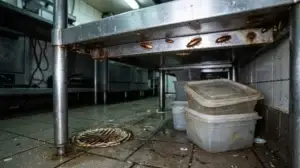
Inspectors are trained to look beyond the obvious. A German roach on a prep surface is a critical violation — but so is roach frass inside a cabinet hinge, rodent droppings behind a reach-in cooler, fruit fly breeding activity in a floor drain, or evidence of rodent gnawing on a structural element. They inspect areas that most kitchen staff never look at — the underside of equipment, the interior of wall voids accessible through utility penetrations, the space between the back of cooking equipment and the wall, and the exterior perimeter of the building for entry points and evidence of pest activity.
Critical violations related to pest activity typically result in immediate corrective action requirements and can trigger re-inspection within days. Repeat violations carry escalating consequences including fines, mandatory closure orders, and in some cases permanent permit revocation.
The documentation trail matters as much as the physical condition of the facility. Inspectors increasingly expect to see evidence of a structured pest management program — service records, treatment logs, technician visit reports, and communication between the pest control provider and facility management. A facility that cannot produce documentation of regular professional pest management is at an immediate disadvantage regardless of its current pest activity levels.
Why Standard Residential-Style Pest Control Fails in Commercial Kitchens
Many food service operators in The Woodlands make the mistake of treating commercial pest control as a scaled-up version of residential service — scheduling a monthly spray visit and considering the obligation met. Commercial kitchen environments are categorically different from residential settings in ways that make residential-style treatment approaches fundamentally inadequate.
Volume and velocity of pest pressure. A busy restaurant generates food debris, moisture, and harborage opportunities at a scale that residential environments never approach. Grease accumulation behind cooking equipment, floor drain buildup, gaps around plumbing penetrations in high-moisture areas, and the constant introduction of pests through deliveries and supply chain entry points create pest pressure that requires a far more intensive and structured management response than a monthly perimeter spray provides.
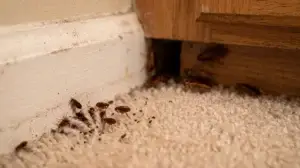
German roach biology in commercial environments. German roaches thrive in commercial kitchens specifically because the environment delivers everything they need — warmth from cooking equipment, moisture from dishwashing and prep areas, food debris from even the most diligent cleaning protocols, and a near-unlimited supply of harborage inside equipment motors, cabinet voids, and wall penetrations. A commercial kitchen German roach population can reach thousands of individuals before becoming visible to kitchen staff, by which point the infestation is already a serious compliance risk.
Fly and drain pest pressure. Fruit flies and phorid flies breed in the organic buildup inside floor drains, under equipment, and in any area where food debris and moisture combine. These breeding sites are invisible from the surface and require specific treatment protocols — drain treatments, enzyme applications, and targeted exclusion — that are outside the scope of standard pest spraying.
Entry point complexity. Commercial food service facilities receive multiple deliveries daily, have loading dock areas with gap-prone door seals, and often share walls or utility infrastructure with adjacent tenants. These structural realities create entry point challenges that residential exclusion work simply does not address. A comprehensive commercial pest program must incorporate ongoing entry point monitoring and structural recommendations as a core component.
Our commercial pest control services are built specifically around these realities, with programs structured for the operational demands of food service environments rather than adapted from residential frameworks.
Critter Gitters’ IPM-Based Approach for Food Service Facilities
Integrated Pest Management — IPM — is the framework that food service regulatory guidance, the National Restaurant Association, and professional pest management industry standards all point to as the appropriate model for commercial kitchen pest defense. IPM is not a single treatment method; it is a structured, documented approach that combines inspection, monitoring, targeted treatment, sanitation guidance, and exclusion work into a cohesive program that addresses pest pressure at its source rather than reacting to visible activity after the fact.
Facility Assessment and Risk Mapping
Every commercial pest program Critter Gitters builds for a food service facility begins with a comprehensive facility assessment. Our technicians conduct a detailed walkthrough of all areas — kitchen, prep areas, dry storage, receiving dock, utility rooms, restrooms, and exterior perimeter — documenting pest activity evidence, identifying structural vulnerabilities, and mapping the specific risk profile of the facility.
This assessment produces a facility-specific treatment plan that targets the actual conditions driving pest pressure in your building rather than applying a generic commercial protocol that was not designed around your facility’s layout, equipment configuration, or operational patterns.
Targeted German Roach Elimination
For food service facilities dealing with German roach activity, Critter Gitters deploys professional gel bait applications in precise harborage placements — inside cabinet hinges, behind equipment, around plumbing penetrations, and in every other area where inspection reveals activity. This targeted bait approach keeps active ingredients away from food preparation surfaces while delivering product directly into the harborage areas where roach populations concentrate.
Insect growth regulators are incorporated to break the breeding cycle, preventing immature roaches from developing into reproductive adults and collapsing population growth even in the most heavily infested environments. Our dedicated German roach clean-out service is available for facilities requiring intensive initial elimination before transitioning to a structured ongoing maintenance program.
Rodent Exclusion and Monitoring
Rodent activity in a commercial kitchen is among the most serious compliance violations an inspector can document. Critter Gitters’ commercial rodent program combines entry point identification and physical exclusion work — sealing gaps around utility penetrations, door sweeps, loading dock seals, and any other structural openings — with interior monitoring station placement and population management. Learn more about our rodent control services and how we approach exclusion in commercial environments.
Drain and Fly Management
Floor drain treatments using enzyme-based products break down the organic buildup that fly species breed in, eliminating breeding sites that contact insecticides cannot address. Combined with targeted adult fly management and sanitation recommendations specific to your facility’s operational patterns, drain management is an essential component of a complete commercial kitchen pest defense program.
Documentation and Compliance Records
Every Critter Gitters service visit to a commercial food service facility is documented with a written service report that records areas inspected, pest activity findings, treatments applied, products used, and any structural or sanitation recommendations. These records are your compliance documentation — available for review during health inspections and demonstrating to inspectors that a structured, professional pest management program is actively in place.
This documentation trail is increasingly the difference between a facility that passes an unannounced inspection confidently and one that scrambles to explain gaps in its pest management history.
The Cost of Inaction vs. The Cost of a Professional Program
The calculation is straightforward. A structured commercial pest control program from Critter Gitters represents a defined, predictable operating cost. A failed health inspection represents a different category of consequence entirely — lost revenue during closure, emergency remediation costs, re-inspection fees, reputational damage that affects customer traffic for months, and in repeat violation scenarios, potential permit consequences that threaten the business itself.
Beyond compliance, pest activity in a food service environment creates direct liability exposure. A customer who encounters a roach, finds evidence of rodent activity, or reports a pest-related illness has a documented basis for legal action. The cost of a single liability event exceeds years of professional pest management program investment.
Food service operators who treat pest control as a discretionary expense rather than a non-negotiable operational requirement consistently face the higher cost — reactive emergency treatment, failed inspections, and reputational recovery — rather than the lower, predictable cost of structured prevention.
Commercial Pest Defense Across The Woodlands and East Texas
Critter Gitters serves a wide range of commercial facility types across The Woodlands and throughout East Texas, including restaurants and food service operations, hotels and hospitality properties, healthcare and medical facilities, schools and childcare centers, retail locations, office buildings, warehouses and distribution centers, and multi-family and apartment communities.
Our Woodlands location serves the full commercial corridor of The Woodlands and surrounding Montgomery County communities. For property management companies overseeing multiple commercial locations, our property management pest control program provides structured, documented service across entire portfolios.
If your food service facility does not currently have a documented, IPM-based commercial pest management program in place — or if your current provider is not delivering the inspection-ready standard your operation requires — contact Critter Gitters today to schedule a commercial facility assessment and build a program that keeps your kitchen compliant, your customers protected, and your business running without interruption.
Critter Gitters Pest Control is a locally owned and operated Texas pest control company proudly serving East Texas homeowners and businesses. From commercial kitchen pest defense and German roach elimination to rodent exclusion, termite protection, and residential pest management — we deliver professional, reliable pest control built for the unique conditions of our region.